Before the Interview, Were You Already Rejected by a Machine?
You spend hours polishing your resume, tailoring your application, and preparing for interviews. But in many organizations today, a human may not be the first one evaluating you. An algorithm might have already made its first judgment before you said a single word.
AI
ZxtarAI
6/12/20263 min read

Before the Interview, Were You Already Rejected by a Machine?
Imagine applying for your dream job. You carefully update your resume, highlight your achievements, and hit the "Submit Application" button with optimism.
What many job seekers don't realize is that their application may never reach a human recruiter. Instead, it could first be reviewed by Artificial Intelligence.
Welcome to the new reality of hiring!!
AI is rapidly transforming recruitment. Organizations receive hundreds, sometimes thousands, of applications for a single position. Reviewing every resume manually is time-consuming, expensive, and often inconsistent.
AI promises to solve this problem. It can scan resumes in seconds, identify relevant skills, rank candidates, schedule interviews, and even analyze video interviews.
For employers, that sounds like a dream. But for candidates, the story is more complicated.
The Good Side of AI Hiring
Let's start with the benefits.
When used responsibly, AI can help organizations make hiring more efficient and potentially fairer.
Instead of recruiters spending days reviewing applications, AI can quickly identify candidates whose skills match job requirements.
This can lead to:
Faster hiring decisions
Reduced administrative workload
Improved candidate experience through quicker responses
Consistent screening criteria across large applicant pools
AI can also help recruiters focus on strategic conversations rather than administrative tasks. In theory, it allows hiring teams to spend more time evaluating people and less time sorting paperwork.
For candidates, faster decisions often mean less waiting and uncertainty.
The Concerns Nobody Can Ignore
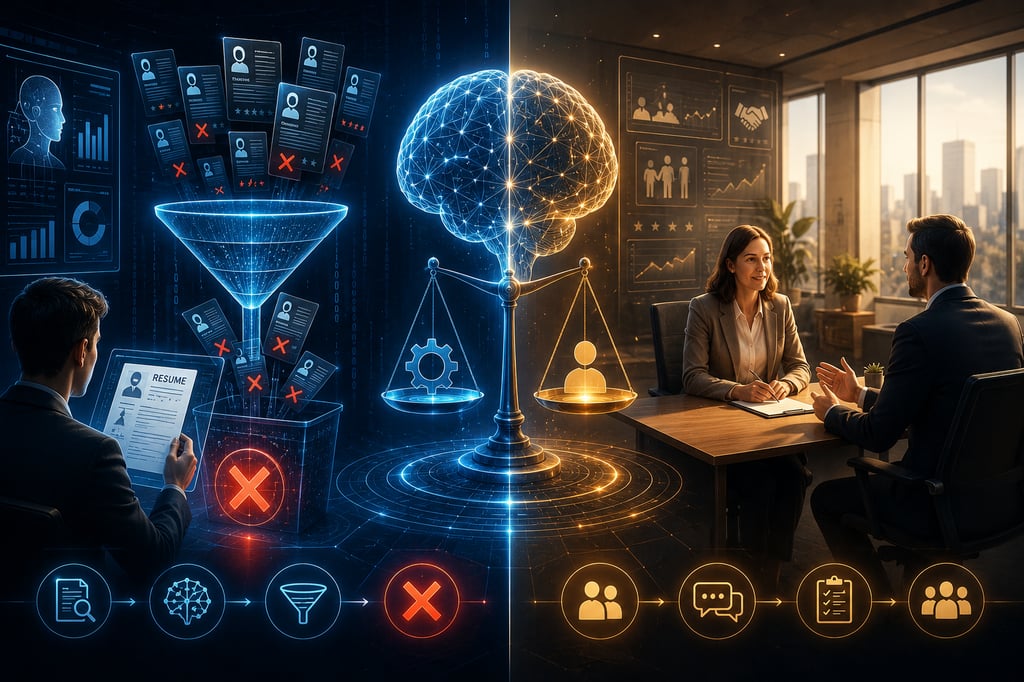
Now for the uncomfortable part. AI learns from data. And if historical hiring data contains bias, AI can unintentionally learn those patterns and repeat them.
For example, if past hiring decisions favored certain backgrounds, universities, industries, or demographics, an AI system may begin viewing those characteristics as indicators of success—even when they aren't.
The result? Qualified candidates might be overlooked without anyone realizing it.
Another challenge is transparency. If an AI system rejects a candidate:
can the candidate understand why?
Can the organization explain the decision?
Can a recruiter challenge the recommendation?
These questions are becoming increasingly important as AI takes on a larger role in employment decisions.
Then there's the issue of privacy. Some advanced hiring tools analyze facial expressions, speech patterns, personality traits, and behavioral signals during interviews.
While these technologies aim to provide additional insights, they also raise concerns about accuracy, fairness, and how much personal data should be collected during the hiring process.
AI Should Assist, Not Replace Human Judgment
Perhaps the biggest misconception is that AI should make hiring decisions independently. Hiring isn't just about keywords and qualifications.
It's about potential.
It's about culture fit.
It's about growth, adaptability, creativity, and qualities that don't always appear neatly on a resume.
A candidate may not check every box on paper but could become an exceptional employee.
That's where human judgment remains essential. The most responsible organizations use AI as a decision-support tool rather than a decision-maker.
AI can help identify patterns and narrow options, but people should remain accountable for final hiring decisions.
What This Means for Job Seekers
AI in hiring isn't going away. In fact, its use will likely continue growing.
For candidates, this means understanding that resumes should be clear, relevant, and aligned with job requirements.
But it also means asking an important question: "How is my application being evaluated?"
Transparency, fairness, and accountability are becoming key expectations in modern recruitment.
Because while AI can help organizations hire faster, candidates deserve confidence that they are being evaluated fairly. At its best, AI can make hiring more efficient. At its worst, it can quietly scale mistakes.
The future of hiring will not be about humans versus AI. It will be about how humans and AI work together to make better decisions than either could make alone.
Key Takeaway
AI can help organizations find talent faster and more efficiently, but speed should never come at the cost of fairness, transparency, or human judgment. The best hiring decisions happen when AI supports recruiters-not when it replaces them.
#AIHiring #RecruitmentTechnology #HRTech #ArtificialIntelligence #ResponsibleAI #AIGovernance #EthicalAI #TalentAcquisition #FutureOfWork #DigitalTrust #HiringBias #PeopleAnalytics #HumanCenteredAI #Leadership #ZxtarAI
Disclaimer: This article is intended for educational and awareness purposes only and should not be considered legal, regulatory, employment, or compliance advice.
© ZxtarAI: Empowering Digital Trust Through AI, Privacy, Security, and Governance Insights.