Is Your AI Tool Legal? Understanding the EU AI Act in Plain English
Artificial Intelligence is evolving faster than most regulations can keep up. The European Union decided to change that by introducing the world's first comprehensive AI law. But what exactly does it ban, allow, and mean for everyday people?
AI GOVERNANCE
ZxtarAI
6/2/20263 min read
Is Your AI Tool Legal? Understanding the EU AI Act in Plain English
When the internet became mainstream, governments spent years figuring out how to regulate it. With Artificial Intelligence, the European Union decided not to wait.
The EU AI Act is the world's first comprehensive law designed specifically to regulate AI systems. Its goal isn't to stop innovation. It's to ensure AI is developed and used safely, transparently, and responsibly.
So, what exactly does this law do? Let's break it down in simple terms.
The Core Idea: Risk-Based Regulation
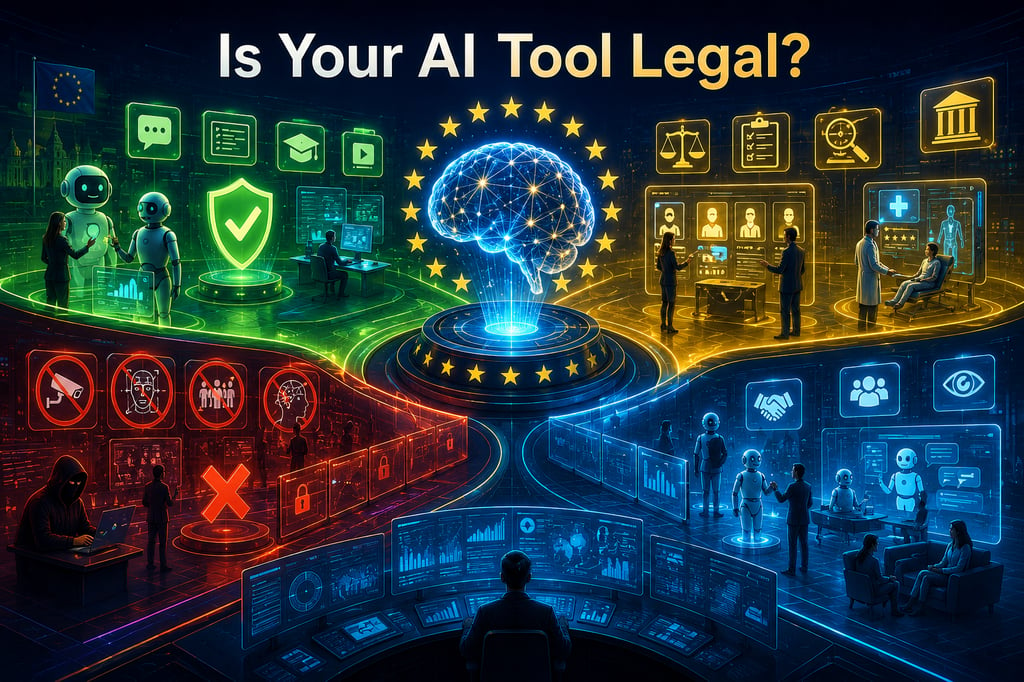
Instead of treating all AI systems the same, the EU AI Act classifies AI according to the level of risk it poses to people.
Think of it like traffic rules. A bicycle, a car, and an airplane don't face the same regulations because they don't carry the same risks. The EU AI Act applies the same logic to AI.
The higher the risk, the stricter the rules.
AI Uses That Are Banned
Some AI applications are considered so harmful that they are prohibited altogether.
Examples include:
AI systems that manipulate people's behavior in harmful ways
Certain forms of social scoring that rank citizens based on behavior
AI that exploits vulnerable groups such as children
Certain real-time biometric surveillance uses in public spaces
The idea is simple: If an AI system threatens fundamental rights, freedoms, or human dignity, it may not be allowed.
AI Uses That Are Allowed but Highly Regulated
Some AI systems are permitted, but they must meet strict requirements before they can be used. These are called high-risk AI systems.
Examples include AI used in:
Hiring and recruitment
Employee evaluation
Education and examinations
Credit scoring
Insurance decisions
Healthcare
Critical infrastructure
Imagine being denied a job, loan, or educational opportunity because of an AI decision.
The EU wants organizations to prove that such systems are accurate, fair, documented, monitored, and subject to human oversight.
In other words, organizations can't simply say, "The AI made the decision." They must be able to explain and justify it.
AI That Most People Use Every Day
Most common AI tools fall into lower-risk categories.
These include:
Chatbots
Content generators
Productivity assistants
Customer support AI
Translation tools
These systems are generally allowed. However, transparency requirements may apply.
For example, users may need to be informed when they are interacting with AI rather than a human. AI-generated content may also require disclosure in certain situations.
The goal is not to restrict useful tools, but to ensure people understand, when AI is involved.
What Does This Mean for Businesses?
For organizations building or deploying AI, the message is clear: Responsible AI is no longer optional.
Companies must think beyond innovation and consider:
Governance
Risk management
Documentation
Human oversight
Transparency
Accountability
Organizations that establish these practices early will likely find compliance easier as AI regulations continue expanding worldwide.
What Does This Mean for You?
Even if you never build an AI model, the EU AI Act still matters. It helps create safeguards around technologies that increasingly influence our lives.
Whether AI is helping screen job applications, recommend loans, assist doctors, or generate online content, people deserve transparency and protection. The EU AI Act represents a broader shift in how society views AI.
For years, the conversation focused on what AI can do. Now regulators are asking a different question:
What should AI be allowed to do?
That question may shape the future of technology for decades to come.
Key Takeaway
The EU AI Act isn't anti-innovation. It's an attempt to balance innovation with responsibility. By banning the most harmful uses, regulating high-risk systems, and promoting transparency, the EU is setting a global benchmark for trustworthy AI.
As AI becomes more powerful, the organizations that earn trust may ultimately gain the greatest advantage.
#EUAIAct #ArtificialIntelligence #AIGovernance #ResponsibleAI #TrustworthyAI #AICompliance #AIRegulation #AIEthics #DigitalTrust #RiskManagement #Privacy #CyberSecurity #FutureOfAI #AILeadership #ZxtarAI
Disclaimer: This article is intended for educational and awareness purposes only and should not be considered legal, regulatory, or compliance advice.
© ZxtarAI - Empowering Digital Trust Through AI, Privacy, Security, and Governance Insights.