The Global Race to Control AI- and Why It's So Complicated
AI is transforming industries, economies, and societies at unprecedented speed. But while its influence continues to grow, a critical question remains unanswered: who is actually responsible for governing AI- and why is no single entity fully in charge? "Gaadi bani, sadak bani - signal abhi bhi nahi laga"
AI GOVERNANCE
ZxtarAI
6/5/20263 min read

The Global Race to Control AI-and Why It's So Complicated
When something affects billions of people, we usually assume someone is in charge.
There are governments regulating airlines. Central banks overseeing financial systems. Traffic authorities managing roads. So naturally, many people assume there must be a single organization somewhere overseeing Artificial Intelligence. But here's the reality:
There is no global "AI boss."
No single government, regulator, company, or international organization has complete control over how AI is developed and used around the world. And that's exactly what makes AI governance one of the most fascinating challenges of our time.
Why AI Is Different
Most technologies stay within industries or geographical boundaries. AI doesn't.
An AI model developed in California can be used by a student in India, a bank in Singapore, a hospital in Germany, and a startup in Brazil - all on the same day. That's great for innovation.
But it creates a difficult question: Whose rules should AI follow?
The answer isn't as straightforward as many people think.
The Governments Are Trying to Catch Up
Governments around the world are working to create laws and regulations for AI. Some focus on privacy. Others focus on transparency, safety, discrimination, or accountability. The challenge is that AI evolves much faster than legislation.
By the time a law is drafted, debated, approved, and implemented, AI technology may have already moved several steps ahead.
As a result, regulators often find themselves trying to catch a moving train.
Interesting Reality: Technology Companies Hold Significant Power
Many of the world's most advanced AI systems are not built by governments. They're built by private companies.
These companies decide:
What models to build
What safeguards to implement
What data to use
What risks to prioritize
Most major AI organizations now have internal governance teams, ethics boards, and safety testing programs. But companies are also competing in a fast-moving market where speed often matters.
Balancing innovation and responsibility is not always easy.
International Organizations Are Setting the Direction
Several international organizations are working to create common principles for responsible AI.
Their goal is to answer questions like:
How should AI be used responsibly?
What rights should individuals have?
How do we reduce bias?
How do we make AI more transparent?
These frameworks provide valuable guidance. However, they generally don't have the power to enforce rules globally.
Think of them more as architects designing the blueprint rather than police officers enforcing the law.
Researchers and Society Play a Bigger Role Than You Think
Many of the biggest AI concerns we discuss today - bias, deepfakes, misinformation, privacy risks - were first highlighted by researchers, academics, journalists, and civil society groups. In many cases, these communities act as an early warning system.
They identify risks before regulators or companies fully recognize them. Without them, many AI-related issues might remain invisible until real harm occurs.
So, Who Governs AI?
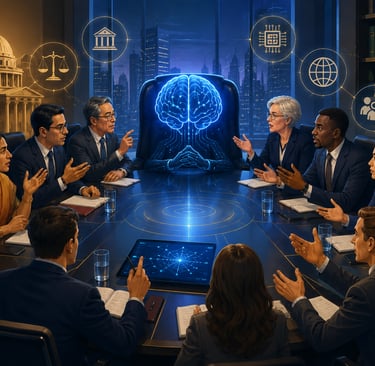
The honest answer is: Everyone governs a piece of it, but nobody governs all of it.
Governments create laws.
Regulators enforce rules.
Companies build the systems.
Standards organizations develop best practices.
Researchers identify risks.
Society decides what is acceptable.
Together, they form an ecosystem of governance. The problem is that the ecosystem isn't always coordinated.
Why This Matters
AI is increasingly influencing decisions that affect people's lives - from hiring and lending to healthcare and education. When something goes wrong, accountability becomes critical.
Who is responsible?
The developer?
The company using the AI?
The regulator?
The answer isn't always clear. And that's one of the biggest governance challenges we face today.
Final Thoughts
The future of AI governance is unlikely to be controlled by a single global authority.
Instead, it will probably emerge through collaboration between governments, businesses, regulators, standards bodies, researchers, and society itself. AI may be one of the most powerful technologies humanities has ever created.
Making sure it remains trustworthy, fair, and accountable is a responsibility that belongs to all of us.
Because the real question isn't whether AI should be governed. It's whether governance can evolve as quickly as AI itself.
#DataPrivacy#DigitalSafety#DigitalLiteracy#KnowYourRights#PrivacyMatters#DigitalIndia#IndiaDigital#TechIndia#DPDPAct#MakeIndiaSafe#AIGovernance#ResponsibleAI#AIEthics#EUAIAct#ArtificialIntelligence#DigitalRights#AIPolicy
Disclaimer: This article is intended for educational and informational purposes only and should not be considered legal, regulatory, or compliance advice.
© ZxtarAI - Understanding the Digital World, One Story at a Time